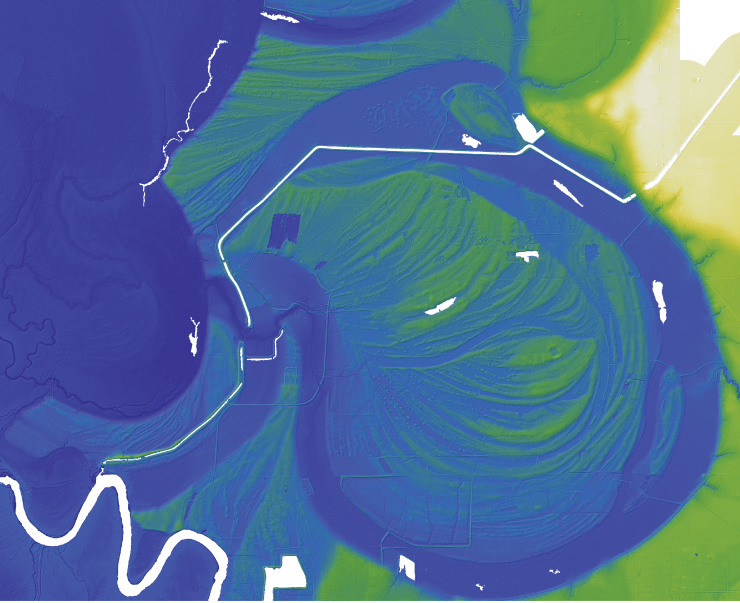
Autogenic versus Allogenic Signal: What terrace-forming processes are preserved on the Trinity River?
The Trinity River, Texas, is contained within terrace walls that formed during the last sea-level fall in the Pleistocene. Past research has postulated that there were three distinct sea level fall and lateral migration periods of the river as these terraces were formed. Using a new high-resolution elevation map produced from airborne lidar (Light Detection and Ranging) over an 80km linear section, we use a statistical approach to assess if each group of terraces is unique and produced by separate external events (autogenic signal). We find that we cannot rule out that terraces were created through continuous processes (autogenic signal) as sea level fell. This research helps develop new metrics to determine if a river terrace belongs to a series of terraces formed during an external change to the river or to a continuous evolution of the river valley as the overall sea-level falls.
Associated Papers
Hassenruck-Gudipati, H.J., Ellis, T., Goudge, T.A., Mohrig, D., (2022). A multi-proxy assessment of terrace formation in the lower Trinity River Valley, Texas. Earth Surface Dynamics, 10, 635-651. https://doi.org/10.5194/esurf-10-635-2022
Methods
Lidar, Monte Carlo simulation, Plane fitting statistics
 Hima Hassenruck-Gudipati